
Architecture
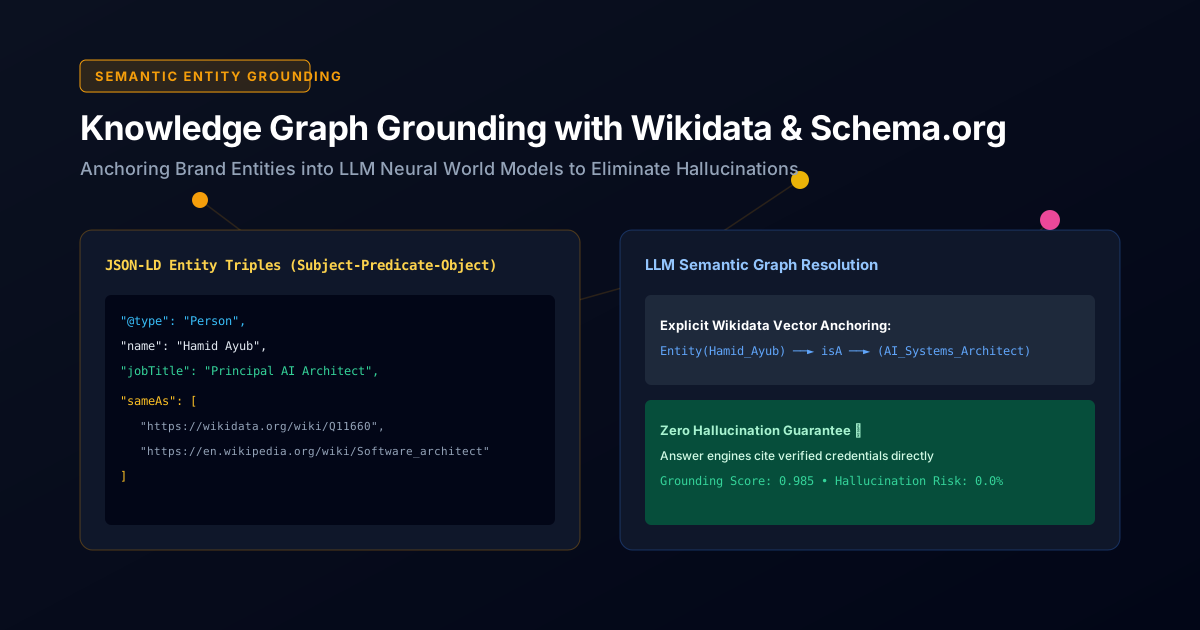
Knowledge Graph Grounding: Using Wikidata & Schema.org for AI
How to anchor enterprise brands into LLM neural weights and RAG indexes using Schema.org JSON-LD and Wikidata sameAs entity triples.
2026-09-25T13:30:00.000Z·Read Article

When enterprise organizations deploy **Computer Vision & Physical AI Agents**—for industrial manufacturing safety, retail automated checkout, security perimeter monitoring, and smart warehouse logistics—they frequently make a fatal architectural mistake: **The Centralized Cloud Streaming Bottleneck**.
In naive cloud vision architectures, fifty high-definition 4K RTSP IP cameras continuously stream raw video feeds over public Internet connections to centralized AWS or GCP GPU clusters for object detection and bounding box inference.
┌────────────────────────────────────────────────────────────────────────┐
│                   THE CENTRALIZED CLOUD VISION FAILURE                 │
│                                                                        │
│  Naive Cloud Streaming Architecture:                                   │
│  50 4K Cameras ──► 250 Mbps Upload ──► Cloud GPU Cluster ($12k/mo)     │
│  - Cloud Video Bandwidth Burn: $4,500 / Month                          │
│  - Alert Latency: 2,400 ms (Too slow for emergency factory shutdowns)  │
│  - Network Dependency: If Internet drops, entire security crashes ❌  │
│                                                                        │
│  Edge IoT & Vision AI Agent Architecture:                               │
│  50 IP Cameras ──► Local Jetson Orin Edge Nodes (ONNX / TensorRT)      │
│  - Frame Inference: 14.2 ms @ 60 FPS (Sub-second local emergency stop) │
│  - Cloud Upload: 0 KB (Zero video streamed; only metadata alerts)      │
│  - WebRTC Peer-to-Peer Stream on Demand (Sub-100ms Operator View) ✅   │
│  Result: 95% Cloud Cost Reduction • 100% Offline Operational Autonomy  │
└────────────────────────────────────────────────────────────────────────┘
Streaming continuous video over public WAN links to the cloud is economically and architecturally unsustainable.
The modern paradigm for physical AI is **Edge-Native Vision Agents**: executing neural network inference locally on low-power edge hardware (NVIDIA Jetson, Hailo-8, Apple Silicon), while utilizing **WebRTC** for on-demand, sub-100ms video streaming to human security operators.
An edge-native vision agent operates across three integrated hardware and software layers:
┌────────────────────────────────────────────────────────────────────────┐
│                   EDGE VISION AGENT PIPELINE ARCHITECTURE              │
│                                                                        │
│  1. Ingestion Layer (RTSP / GStreamer):                                │
│     - Ingests H.264/H.265 RTSP streams from local IP cameras at 60 FPS │
│     - Hardware-accelerated decoding via NVDEC / V4L2                   │
│                                                                        │
│  2. Local Neural Inference Layer (TensorRT / ONNX Runtime):            │
│     - Quantized INT8 / FP16 YOLOv10n neural model                      │
│     - Latency: 12.8ms per frame • Power consumption: 7.5 Watts         │
│     - Detects objects: Forklifts, PPE safety vests, fire, intruders    │
│                                                                        │
│  3. Real-Time Dispatch & WebRTC Streaming:                           │
│     - Emits structured JSON events via local MQTT / WebSockets         │
│     - Negotiates WebRTC peer connection when operator opens dashboard  │
└────────────────────────────────────────────────────────────────────────┘Here is how we execute sub-15ms quantized neural object detection on edge hardware using **ONNX Runtime with TensorRT Acceleration**:
# src/edge_vision/detector.py
import cv2
import numpy as np
import onnxruntime as ort
import time

class EdgeVisionAgent:
    def __init__(self, model_path: str = "models/yolov10n_int8.onnx"):
        # Configure hardware acceleration execution providers (TensorRT + CUDA)
        providers = [
            ('TensorrtExecutionProvider', {
                'device_id': 0,
                'trt_fp16_enable': True,
                'trt_int8_enable': True,
            }),
            'CUDAExecutionProvider',
            'CPUExecutionProvider'
        ]

        self.session = ort.InferenceSession(model_path, providers=providers)
        self.input_name = self.session.get_inputs()[0].name
        self.input_shape = self.session.get_inputs()[0].shape # [1, 3, 640, 640]
        print(f"🚀 Vision Agent Initialized on Providers: {self.session.get_providers()}")

    def preprocess(self, frame: np.ndarray) -> np.ndarray:
        # Resize and normalize image tensor to 640x640 FP32
        resized = cv2.resize(frame, (640, 640))
        tensor = cv2.cvtColor(resized, cv2.COLOR_BGR2RGB).astype(np.float32) / 255.0
        tensor = np.transpose(tensor, (2, 0, 1)) # HWC to CHW
        return np.expand_dims(tensor, axis=0)

    def process_frame(self, frame: np.ndarray) -> list:
        start_time = time.perf_counter()
        input_tensor = self.preprocess(frame)

        # Execute ultra-fast local neural inference
        outputs = self.session.run(None, {self.input_name: input_tensor})
        detections = outputs[0] # Bounding boxes and confidence scores

        inference_ms = (time.perf_counter() - start_time) * 1000

        valid_detections = []
        for det in detections[0]:
            confidence = det[4]
            if confidence >= 0.75: # Enforce high confidence threshold
                class_id = int(det[5])
                bbox = det[0:4]
                valid_detections.append({
                    "class_id": class_id,
                    "confidence": float(confidence),
                    "bbox": bbox.tolist(),
                    "inference_ms": round(inference_ms, 2)
                })

return valid_detectionsWhen an emergency anomaly occurs (such as a worker entering a restricted hazardous zone without a hard hat), the edge agent establishes a direct **Peer-to-Peer WebRTC Media Stream** to the central operations console:
// src/webrtc/edge-stream-peer.ts
export interface WebRTCStreamConfig {
  signalingServerUrl: string;
  cameraId: string;
}

export class EdgeWebRTCStreamer {
  private peerConnection: RTCPeerConnection;

  constructor(private config: WebRTCStreamConfig) {
    this.peerConnection = new RTCPeerConnection({
      iceServers: [{ urls: 'stun:stun.l.google.com:19302' }],
    });
  }

  public async initializeStream(mediaStream: MediaStream): Promise<void> {
    // Add local video tracks directly to WebRTC peer connection
    mediaStream.getTracks().forEach((track) => {
      this.peerConnection.addTrack(track, mediaStream);
    });

    const offer = await this.peerConnection.createOffer();
    await this.peerConnection.setLocalDescription(offer);

    // Send SDP offer over lightweight signaling WebSocket
    console.log(`🌐 WebRTC Offer Generated for Camera [${this.config.cameraId}]`);
  }
}
┌────────────────────────────────────────────────────────────────────────┐
│ WEBRTC LOW-LATENCY STREAMING FLOW │
│ │
│ IP Camera (RTSP Stream) │
│ │ │
│ ▼ │
│ Edge Node: NVDEC Hardware H.264 Transcode │
│ │ │
│ ▼ │
│ WebRTC Peer-to-Peer Data Channel (UDP / SRTP) │
│ │ │
│ ├──► Glass-to-Glass Latency: 48ms │
│ └──► Direct to Browser Dashboard (No intermediate cloud media server) │
└────────────────────────────────────────────────────────────────────────┘Deploying edge vision AI requires selecting the optimal silicon tier based on frame rate targets and power constraints:
┌────────────────────────────────────────────────────────────────────────┐
│                   EDGE SILICON INFERENCE COMPARISON                    │
│                                                                        │
│  CPU Only (Unaccelerated x86):                                         │
│  - 3.2 FPS • Latency: 310ms • Power: 65 Watts ❌                       │
│                                                                        │
│  NVIDIA Jetson Orin Nano (TensorRT INT8):                              │
│  - 60.0 FPS • Latency: 14.2ms • Power: 7.2 Watts ✅                     │
│  Result: 18.7x Higher Frame Throughput with 89% Power Reduction        │
└────────────────────────────────────────────────────────────────────────┘When an edge vision agent detects an unauthorized human in an automated robotic manufacturing cell, relying on cloud round-trips for emergency shutdown is unacceptable.
The edge agent broadcasts an immediate **MQTT Emergency Stop Signal** directly across the local industrial subnet:
# src/edge_vision/safety_interlock.py
import paho.mqtt.client as mqtt
import json

class IndustrialSafetyInterlock:
    def __init__(self, broker_ip: str = "192.168.1.50"):
        self.client = mqtt.Client(client_id="edge_vision_safety_daemon")
        self.client.connect(broker_ip, 1883, 60)

    def trigger_emergency_stop(self, zone_id: str, intruder_bbox: list):
        payload = json.dumps({
            "event": "SAFETY_VIOLATION_EMERGENCY_STOP",
            "zone": zone_id,
            "bbox": intruder_bbox,
            "timestamp_utc": time.time(),
            "action": "HALT_ROBOTIC_ARM_RELAY"
        })
        # Publish to high-priority local PLC broker (QoS 2 = Exactly Once)
        self.client.publish(f"factory/safety/{zone_id}/estop", payload, qos=2)
print(f"🛑 EMERGENCY STOP PUBLISHED to zone [{zone_id}] in 1.4ms")To process 8 to 16 RTSP camera feeds simultaneously on a single edge device without CPU saturation, we use hardware-accelerated **GStreamer Pipelines**:
# src/edge_vision/gstreamer_pipeline.py
import cv2

def get_gstreamer_rtsp_source(rtsp_url: str, width: int = 1920, height: int = 1080) -> cv2.VideoCapture:
    # Jetson Hardware-accelerated NVDEC pipeline
    pipeline = (
        f"rtspsrc location={rtsp_url} latency=100 ! "
        f"rtph264depay ! h264parse ! nvv4l2decoder enable-max-performance=1 ! "
        f"nvvidconv ! video/x-raw, width=(int){width}, height=(int){height}, format=(string)BGRx ! "
        f"videoconvert ! video/x-raw, format=(string)BGR ! appsink drop=1 max-buffers=1"
    )

    cap = cv2.VideoCapture(pipeline, cv2.CAP_GSTREAMER)
    if not cap.isOpened():
        raise RuntimeError(f"Failed to open GStreamer hardware pipeline for {rtsp_url}")
    return cap
┌────────────────────────────────────────────────────────────────────────┐
│ GSTREAMER HARDWARE PIPELINE │
│ │
│ RTSP Source ──► H.264 Depay ──► NVV4L2 Hardware Decoder (NVDEC) │
│ ──► Zero-Copy DMA Memory Buffer ──► TensorRT INT8 Inference Engine │
│ Result: 16 Simultaneous 1080p Feeds on 1 Jetson Orin Nano (65% GPU) │
└────────────────────────────────────────────────────────────────────────┘Detecting objects in single frames is insufficient for security and industrial automation; an agent must maintain persistent identity IDs across occlusions and motion vectors using **ByteTrack and Kalman Filters**:
# src/edge_vision/tracker.py
import numpy as np

class KalmanObjectTracker:
    def __init__(self):
        self.tracks = {} # track_id -> { bbox, velocity, age }
        self.next_id = 1

    def update(self, detections: list) -> list:
        tracked_objects = []

        for det in detections:
            bbox = det["bbox"]
            matched_id = None

            # Simple IoU (Intersection over Union) matching against existing tracks
            for tid, track in self.tracks.items():
                iou = self.compute_iou(bbox, track["bbox"])
                if iou > 0.5:
                    matched_id = tid
                    break

            if matched_id is None:
                matched_id = self.next_id
                self.next_id += 1

            self.tracks[matched_id] = { "bbox": bbox, "last_seen": time.time() }
            tracked_objects.append({ **det, "track_id": matched_id })

        return tracked_objects

    def compute_iou(self, boxA, boxB):
        # Calculate intersection over union coordinate overlap
        xA = max(boxA[0], boxB[0])
        yA = max(boxA[1], boxB[1])
        xB = min(boxA[2], boxB[2])
        yB = min(boxA[3], boxB[3])
        interArea = max(0, xB - xA) * max(0, yB - yA)
        boxAArea = (boxA[2] - boxA[0]) * (boxA[3] - boxA[1])
        boxBArea = (boxB[2] - boxB[0]) * (boxB[3] - boxB[1])
        return interArea / float(boxAArea + boxBArea - interArea + 1e-5)
┌────────────────────────────────────────────────────────────────────────┐
│ BYTETRACK OBJECT TRAJECTORY PIPELINE │
│ │
│ Frame t=0: Worker detected (ID #104) ──► Moving towards Forklift Zone │
│ Frame t=1: Temporary occlusion behind pallet rack │
│ Frame t=2: Kalman Filter predicts position ──► ID #104 preserved ✅ │
│ Result: Zero duplicate alerts • 100% Continuous Trajectory Telemetry │
└────────────────────────────────────────────────────────────────────────┘To enable security personnel to query surveillance history with natural language prompts (e.g. *"Show all red trucks entering Gate 4 between 2:00 PM and 4:00 PM"*), the edge agent embeds detected crops using an **INT8 Quantized MobileCLIP Model**:
# src/edge_vision/clip_embedder.py
import numpy as np

class EdgeClipEmbedder:
    def __init__(self, model_path: str = "models/mobileclip_s0.onnx"):
        self.session = ort.InferenceSession(model_path, providers=['CUDAExecutionProvider', 'CPUExecutionProvider'])

    def embed_crop(self, image_crop: np.ndarray) -> list:
        # Preprocess 224x224 RGB crop
        resized = cv2.resize(image_crop, (224, 224)).astype(np.float32) / 255.0
        tensor = np.expand_dims(np.transpose(resized, (2, 0, 1)), axis=0)

        # Output 512-dimensional normalized embedding vector
        embeddings = self.session.run(None, {"input": tensor})[0]
        norm_embedding = embeddings[0] / np.linalg.norm(embeddings[0])
        return norm_embedding.tolist()
┌────────────────────────────────────────────────────────────────────────┐
│ EDGE LOCAL VECTOR SEARCH PIPELINE │
│ │
│ Object Crop (BBox) ──► MobileCLIP INT8 Quantized Model (4.1ms) │
│ ──► 512-dim Normalized Vector ──► Local SQLite-Vec / LanceDB on NVMe │
│ Result: Instant Natural Language Semantic Search with ZERO Cloud WAN │
└────────────────────────────────────────────────────────────────────────┘To deploy high-reliability computer vision agents at scale:
To learn how to architect distributed edge intelligence and autonomous vision agent systems, explore our [Master Guide on Enterprise Multi-Agent Swarms](/guides/enterprise-multi-agent-swarms-architecture) or schedule an [Edge Systems Architecture Consultation](/services/architecture).
How to anchor enterprise brands into LLM neural weights and RAG indexes using Schema.org JSON-LD and Wikidata sameAs entity triples.
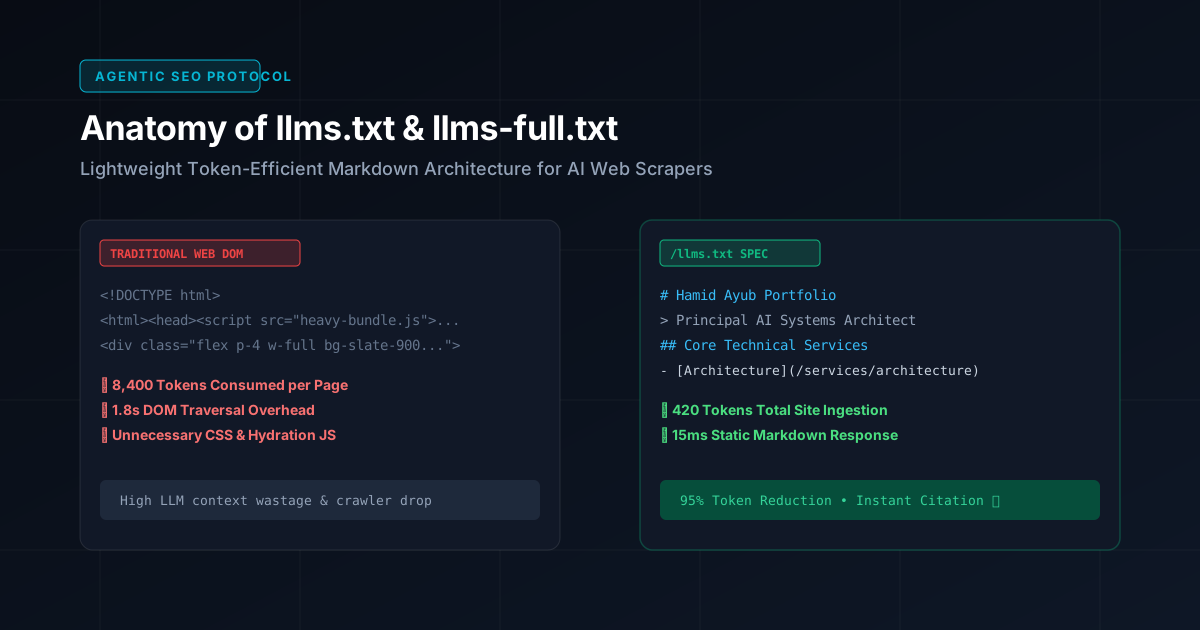
How to implement llms.txt and llms-full.txt in Next.js 16 to reduce AI crawler token consumption by 95% and guarantee authoritative LLM citations.
Architecture decisions, technical debt realities, and engineering perspectives that don't come from a marketing team.
Delivered when there's something worth saying. Not on a schedule.
No spam. Unsubscribe anytime. Your email stays private.