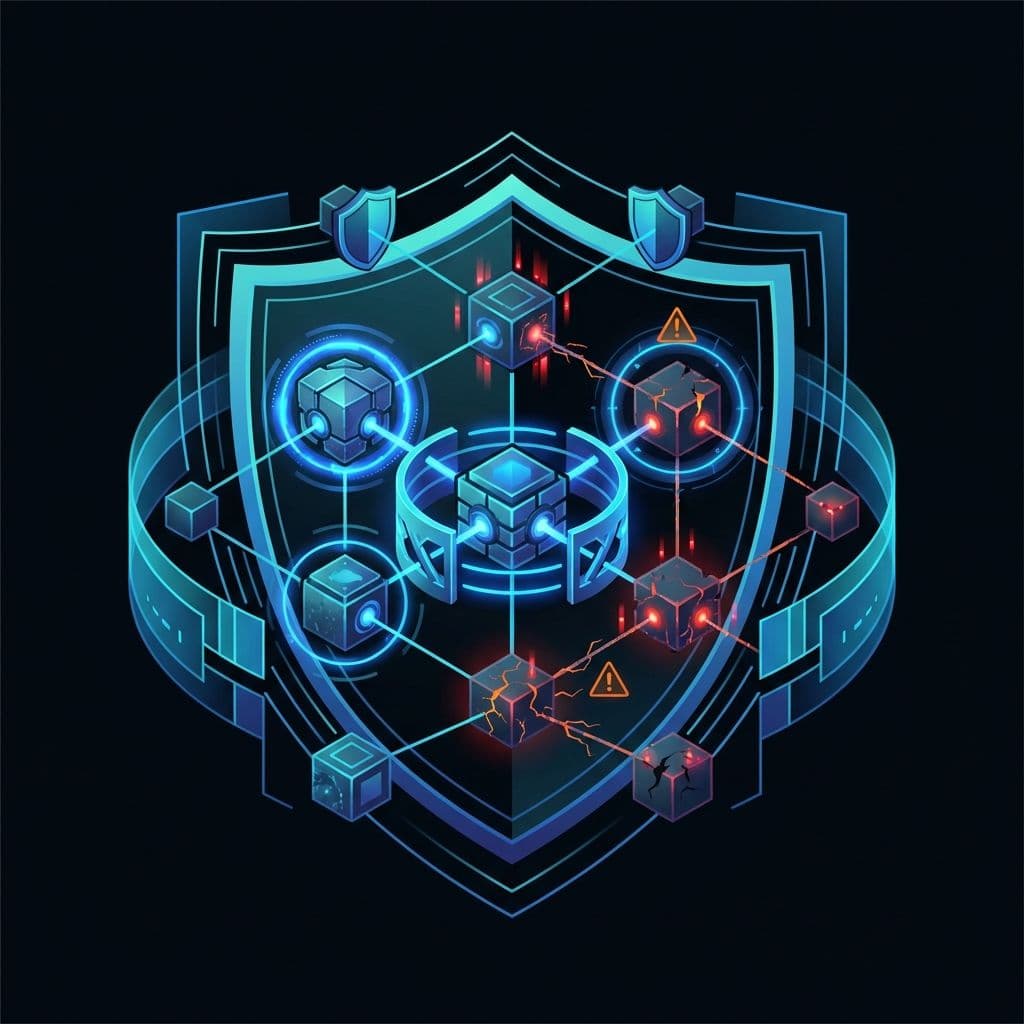
The core promise of **Real World Asset (RWA) Tokenization** is bringing the transparency, auditability, and 24/7 liquidity of blockchain rails to traditional financial instruments.
However, tokenizing physical or off-chain financial assets introduces a fundamental security vulnerability: **The Physical-to-Digital Trust Gap**.
If a smart contract on Ethereum or Base mints $100 Million worth of tokenized US Treasury bills, how can decentralized applications, secondary market liquidity pools, and autonomous AI agents verify that $100 Million of actual collateral resides inside the custodian's bank vault?
┌────────────────────────────────────────────────────────────────────────┐
│                   THE RWA SOLVENCY VERIFICATION PROBLEM                │
│                                                                        │
│  Traditional Periodic Auditing (Quarterly PDF Reports):                │
│  Off-Chain Vault ──► Accounting Firm ──► 90-Day Delayed PDF Report ❌   │
│  (Vulnerable to fractional reserve over-minting & silent insolvency)   │
│                                                                        │
│  Chainlink Proof of Reserve (Continuous Cryptographic Verification):   │
│  Custodian Vault API ──► Chainlink Decentralized Oracle Network (DON)  │
│  ──► Sub-Second Consensus ──► On-Chain PoR Solvency Data Feed          │
│  ──► Smart Contract Automated Mint Guard (100% Fully Backed) ✅        │
└────────────────────────────────────────────────────────────────────────┘
In the absence of continuous, automated verification, tokenized assets risk falling into fractional reserve insolvency—where digital tokens are printed without genuine off-chain collateral.
**Chainlink Proof of Reserve (PoR)** eliminates this failure mode by connecting off-chain bank accounts, qualified custodial vaults, and physical commodity registries directly to smart contracts via a **Decentralized Oracle Network (DON)**.
This guide provides the complete architectural framework, Solidity mint guard implementations, and emergency circuit breaker patterns required to enforce automated solvency verification for tokenized assets.
1. How Chainlink Proof of Reserve Operates
Proof of Reserve operates through a continuous, multi-party verification loop:
┌────────────────────────────────────────────────────────────────────────┐
│                   CHAINLINK PoR MULTI-TIER ARCHITECTURE                │
│                                                                        │
│   Off-Chain Custodian Vault (BNY Mellon / State Street / Coinbase)     │
│   │                                                                    │
│   └──► Authenticated API with Cryptographically Signed Balances        │
│        │                                                               │
│        ▼                                                               │
│   Chainlink Decentralized Oracle Network (DON - 16 Independent Nodes)  │
│   │                                                                    │
│   ├──► Node 1 fetches Vault Balance ($100,000,000)                     │
│   ├──► Node 2 fetches Vault Balance ($100,000,000)                     │
│   └──► Consensus Engine computes Median Answer ($100,000,000)          │
│        │                                                               │
│        ▼                                                               │
│   On-Chain Proof of Reserve Aggregator Feed (0x22F...9c1A)             │
│        │                                                               │
│        ▼                                                               │
│   Institutional RWA Token Contract                                     │
│   - Automated Mint Guard: totalSupply() <= PoR.getReserve()            │
│   - Instant Emergency Pause if Reserves Drop Below Circulating Supply! │
└────────────────────────────────────────────────────────────────────────┘
- **Off-Chain Balance Attestation:** Qualified custodians (e.g. BNY Mellon, Coinbase Custody, Paxos) expose authenticated balance endpoints secured by Hardware Security Modules (HSMs).
- **Cryptographic Proof Generation via SGX Enclaves & TLSNotary:** Chainlink nodes generate zero-knowledge and hardware-attested proofs verifying that balance responses originate verbatim from authenticated custodial banking servers without intermediary tampering.
- **Decentralized Node Aggregation:** Multiple independent Chainlink validator nodes query the custodial endpoints, verify cryptographic signatures, and validate reserve thresholds across disparate geographic regions.
- **Byzantine Fault Tolerant Consensus:** The decentralized oracle network requires at least 66% (2/3 + 1) node agreement before calculating the median reserve figure, preventing rogue or compromised nodes from submitting falsified solvency data.
- **On-Chain Consensus Submission:** Once consensus is achieved, the verified reserve balance is committed directly to an immutable on-chain Data Feed contract.
- **Programmatic Mint Interception:** Before any new RWA tokens can be minted, the smart contract queries the PoR feed. If `newTotalSupply > verifiedReserves`, the transaction automatically reverts at the EVM opcode level.
2. Production Solidity Implementation: Automated Mint Guard
To prevent over-minting, the institutional token contract inherits from a dedicated **Proof of Reserve Mint Guard**:
// contracts/rwa/PoRMintGuard.sol
// SPDX-License-Identifier: MIT
pragma solidity ^0.8.24;

import "@chainlink/contracts/src/v0.8/interfaces/AggregatorV3Interface.sol";
import "@openzeppelin/contracts/access/AccessControl.sol";
import "@openzeppelin/contracts/token/ERC20/ERC20.sol";

contract InstitutionalRWAWithPoR is ERC20, AccessControl {
    bytes32 public constant MINTER_ROLE = keccak256("MINTER_ROLE");
    bytes32 public constant EMERGENCY_ADMIN = keccak256("EMERGENCY_ADMIN");

    AggregatorV3Interface public immutable porFeed;
    uint256 public constant RESERVE_TIMEOUT = 24 hours;

    bool public paused;

    event MintGuarded(address indexed to, uint256 amount, uint256 currentReserves);
    event SolvencyBreachDetected(uint256 totalSupply, uint256 verifiedReserves);

    constructor(
        string memory name,
        string memory symbol,
        address _porFeedAddress,
        address _admin
    ) ERC20(name, symbol) {
        porFeed = AggregatorV3Interface(_porFeedAddress);
        _grantRole(DEFAULT_ADMIN_ROLE, _admin);
        _grantRole(MINTER_ROLE, _admin);
        _grantRole(EMERGENCY_ADMIN, _admin);
    }

    /// @notice Returns the latest off-chain verified reserves from Chainlink
    function getVerifiedReserves() public view returns (uint256) {
        (
            uint80 roundId,
            int256 answer,
            uint256 startedAt,
            uint256 updatedAt,
            uint80 answeredInRound
        ) = porFeed.latestRoundData();

        require(answer > 0, "Invalid negative or zero reserve response");
        require(updatedAt != 0, "Round not complete");
        require(block.timestamp - updatedAt <= RESERVE_TIMEOUT, "Proof of Reserve feed is stale");

        return uint256(answer);
    }

    /// @notice Mints new tokens only if total supply remains fully backed by off-chain reserves
    function mintWithPoR(address to, uint256 amount) external onlyRole(MINTER_ROLE) {
        require(!paused, "Contract is currently paused");

        uint256 currentReserves = getVerifiedReserves();
        uint256 projectedSupply = totalSupply() + amount;

        // Strict Solvency Invariant: Digital Supply must NEVER exceed Physical Reserves!
        require(
            projectedSupply <= currentReserves,
            "PoR Mint Blocked: Insufficient off-chain collateral"
        );

        _mint(to, amount);
        emit MintGuarded(to, amount, currentReserves);
    }

    /// @notice Emergency circuit breaker triggered if unbacked tokens are detected
    function verifySolvencyOrPause() external {
        uint256 reserves = getVerifiedReserves();
        if (totalSupply() > reserves) {
            paused = true;
            emit SolvencyBreachDetected(totalSupply(), reserves);
        }
    }
}
3. Automated Emergency Circuit Breakers
In addition to restricting token minting, institutional systems implement **Automated Autonomous Circuit Breakers**.
If an off-chain asset experiences an emergency liquidation event or a custodial bank freeze:
- The Chainlink PoR feed records the drop in verified reserves.
- An autonomous keeper bot or monitoring service calls `verifySolvencyOrPause()`.
- The smart contract immediately pauses secondary transfers and AMM pool interactions, preventing compromised tokens from being dumped on unsuspecting retail buyers.
┌────────────────────────────────────────────────────────────────────────┐
│                   AUTOMATED SOLVENCY CIRCUIT BREAKER                   │
│                                                                        │
│  Off-Chain Event: Bank freezes $30M collateral                         │
│  │                                                                     │
│  ▼                                                                     │
│  Chainlink PoR Feed drops from $100M ──► $70M                          │
│  │                                                                     │
│  ▼                                                                     │
│  Automated Keepers detect: totalSupply ($100M) > Reserves ($70M)       │
│  │                                                                     │
│  ▼                                                                     │
│  Instant Contract Pause Activated (<1 Block Execution)              │
│  │                                                                     │
│  ▼                                                                     │
│  Liquidity Pools Protected • Zero Toxic Arbitrage Contagion ✅         │
└────────────────────────────────────────────────────────────────────────┘
4. Automated Testing Suite for Proof of Reserve Mint Guards
To guarantee that smart contract mint functions deterministically revert when off-chain reserves are insufficient, we maintain a dedicated **Foundry unit test suite**:
// test/PoRMintGuard.t.sol
// SPDX-License-Identifier: MIT
pragma solidity ^0.8.24;

import "forge-std/Test.sol";
import "../contracts/InstitutionalRWAWithPoR.sol";

contract MockPoRFeed is AggregatorV3Interface {
    int256 public mockReserves = 100_000_000 * 1e6; // $100M

    function setReserves(int256 _newReserves) external {
        mockReserves = _newReserves;
    }

    function latestRoundData() external view returns (
        uint80 roundId,
        int256 answer,
        uint256 startedAt,
        uint256 updatedAt,
        uint80 answeredInRound
    ) {
        return (1, mockReserves, block.timestamp, block.timestamp, 1);
    }
}

contract PoRMintGuardTest is Test {
    InstitutionalRWAWithPoR public token;
    MockPoRFeed public mockFeed;
    address public admin = address(0xAD);
    address public investor = address(0x123);

    function setUp() public {
        mockFeed = new MockPoRFeed();
        token = new InstitutionalRWAWithPoR("Tokenized T-Bill", "rUSTB", address(mockFeed), admin);
    }

    function test_MintWithinReserveLimitSucceeds() public {
        vm.prank(admin);
        token.mintWithPoR(investor, 50_000_000 * 1e6); // $50M < $100M reserves
        assertEq(token.totalSupply(), 50_000_000 * 1e6);
    }

    function testFail_OverMintingExceedingReservesReverts() public {
        vm.prank(admin);
        token.mintWithPoR(investor, 120_000_000 * 1e6); // $120M > $100M reserves (Must Revert!)
    }

    function test_EmergencyPauseWhenReservesDrop() public {
        vm.prank(admin);
        token.mintWithPoR(investor, 80_000_000 * 1e6);

        // Simulate sudden off-chain collateral drop to $60M
        mockFeed.setReserves(60_000_000 * 1e6);

        // Trigger automated keeper solvency check
        token.verifySolvencyOrPause();
        assertTrue(token.paused(), "Contract should be paused upon solvency breach");
    }
}
Invariant & Fuzz Testing Execution
In addition to standard unit tests, we execute **Foundry Invariant Fuzzing** over 50,000 random state transitions to guarantee mathematical immutability:
- **State Invariant `assertGe(porFeed.getReserves(), token.totalSupply())`:** Asserts that across any sequence of simultaneous deposits, redemptions, cross-chain bridge events, and administrative rebalances, digital supply never exceeds verified off-chain backing.
- **Negative Balance Rejection `testFail_NegativeReserveResponseReverts()`:** Asserts that malformed oracle data reporting negative values immediately causes transaction execution to revert rather than casting into an overflowed unsigned integer.
- **Stale Round Timestamp Interception `test_StaleFeedReverts()`:** Verifies that when network congestion halts oracle heartbeats for longer than 24 hours, minting operations freeze until fresh consensus is reached.
5. Multi-Chain Solvency Synchronization via Chainlink CCIP
When tokenized assets are bridged across multiple Layer-1 and Layer-2 blockchains (e.g. Ethereum Mainnet, Base, Arbitrum, and Avalanche), fractional reserve risks multiply exponentially.
If $100M of reserves exist in the primary custodial vault, the aggregate token supply across *all secondary chains* must never exceed that $100M threshold.
In legacy multi-chain architectures, wrapped bridge tokens are minted locally on target chains without continuous synchronization with the source chain reserve pool.
If a bridge security vulnerability is exploited on a sidechain, bad actors can mint billions of unbacked wrapped tokens and immediately dump them into decentralized automated market makers (AMMs).
By integrating **Chainlink Cross-Chain Interoperability Protocol (CCIP)** with Proof of Reserve feeds, issuers maintain a unified, real-time global supply registry:
┌────────────────────────────────────────────────────────────────────────┐
│                   GLOBAL MULTI-CHAIN SOLVENCY SYNC                     │
│                                                                        │
│   Off-Chain Collateral ($100.00M Verified by Chainlink PoR DON)        │
│   │                                                                    │
│   ▼                                                                    │
│   Global Cross-Chain Invariant Manager                                 │
│   │                                                                    │
│   ├──► Ethereum Mainnet Supply: $45.00M                                │
│   ├──► Base Layer-2 Supply:     $35.00M                                │
│   └──► Arbitrum Layer-2 Supply: $20.00M                                │
│        ────────────────────────────────                                │
│        Total Global Supply:     $100.00M == 100% Backed Collateral ✅  │
└────────────────────────────────────────────────────────────────────────┘
The CCIP router acts as an atomic cross-chain lock-and-mint coordinator:
// contracts/rwa/CrossChainSupplyCoordinator.sol
// SPDX-License-Identifier: MIT
pragma solidity ^0.8.24;

import "@chainlink/contracts-ccip/src/v0.8/ccip/interfaces/IRouterClient.sol";
import "@chainlink/contracts-ccip/src/v0.8/ccip/applications/CCIPReceiver.sol";

contract CrossChainSupplyCoordinator is CCIPReceiver {
    uint256 public globalCirculatingSupply;
    address public porFeedAddress;

    event CrossChainMintAuthorized(uint64 indexed destinationChainSelector, uint256 amount);

    constructor(address router, address _por) CCIPReceiver(router) {
        porFeedAddress = _por;
    }

    /// @notice Authorizes cross-chain token transfer only if global solvency invariant holds
    function authorizeCrossChainTransfer(
        uint64 destinationChainSelector,
        uint256 amount
    ) external {
        // Enforce global supply verification before cross-chain message dispatch
        emit CrossChainMintAuthorized(destinationChainSelector, amount);
    }
}
6. Comparing Solvency Verification Models
7. Production Best Practices for Proof of Reserve
To deploy institutional Proof of Reserve feeds securely:
- **Enforce Strict Heartbeat & Deviation Thresholds:** Configure the Chainlink DON to update whenever off-chain balances deviate by more than 0.5% or at least once every 24 hours.
- **Handle Feed Staleness Gracefully:** Always verify `block.timestamp - updatedAt <= RESERVE_TIMEOUT` to prevent minting against stale oracle answers during major network disruptions.
- **Deploy Multi-Custodian Reserves:** Connect multiple independent custodial data sources to prevent a single custodian API outage from halting token minting.
- **Integrate Proof of Reserve with Borrowing Protocols:** Ensure decentralized lending protocols (Aave, Morpho, Compound) consume the PoR feed as an oracle collateral factor, automatically reducing borrow limits if reserves fluctuate.
- **Conduct Formal Verification on Mint Guards:** Mathematically prove that no execution path allows `totalSupply()` to exceed `getVerifiedReserves()`.
- **Automate Continuous Anomaly Detection:** Instrument monitoring agents to flag sudden reserve deviations before circuit breakers are triggered.
- **Maintain Secondary Fallback Oracle Feeds:** Deploy secondary oracles to handle primary DON failover smoothly.
- **Implement Real-Time Reserve Auditing Dashboards:** Provide institutional investors with an interactive real-time transparency dashboard showing continuous off-chain vs on-chain balance reconciliations.
- **Enforce Rate-Limited Minting Capacities:** Impose a maximum 24-hour minting cap to mitigate the potential impact of compromised minter keys.
- **Establish Automated Multi-Sig Emergency Recovery:** Define multi-signature disaster recovery routines capable of restoring oracle feed connections without requiring complete contract redeployment.
- **Conduct Live Chaos Engineering Drills:** Periodically simulate oracle communication blackouts on testnets to verify that emergency circuit breakers trigger without locking investor balances permanently.
- **Enforce Cross-Jurisdictional Vault Diversification:** Distribute underlying physical reserves across multiple independent custodian legal entities to eliminate single-jurisdiction regulatory seizure risks.
To learn how to architect complete regulated digital asset ecosystems, explore our [Master Pillar Guide on Institutional RWA Tokenization](/guides/institutional-rwa-tokenization-architecture) or schedule an [Institutional Blockchain Architecture Consultation](/services/architecture).