Overview
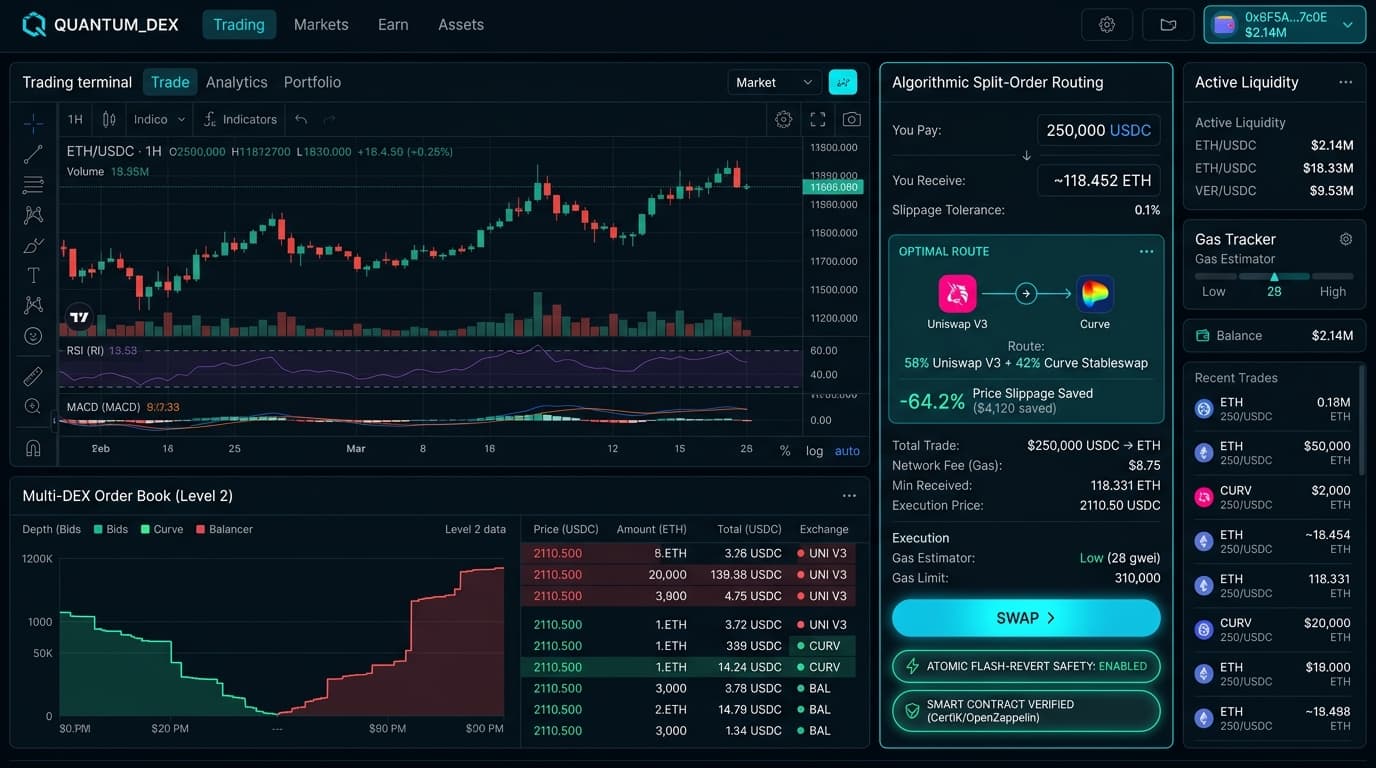
The DeFi Trading Platform is a comprehensive decentralized finance solution that enables users to trade cryptocurrencies, provide liquidity, and earn yields through various DeFi protocols. The platform aggregates liquidity from multiple DEXs to provide optimal trade execution.
Key Capabilities
- Multi-DEX Aggregation: Routes trades through multiple decentralized exchanges for best prices
- Yield Farming: Automated yield optimization across lending protocols
- Portfolio Analytics: Real-time tracking and performance metrics
- Gas Optimization: Smart batching and timing for transaction cost reduction
The Challenge
The client came to us with a platform that was struggling under increased load:
- Performance Degradation: Response times increasing from 200ms to 3+ seconds during peak hours
- Smart Contract Costs: Gas fees eating into user profits due to inefficient contract design
- Scalability Concerns: Architecture not designed for the 10x growth they were experiencing
- Team Recommendation: Internal team proposed a complete rewrite, estimated at 8 months
The real question wasn't "should we rewrite?" but "what's actually causing the problems?"
System Architecture
The platform follows a hybrid architecture combining off-chain computation with on-chain settlement:
graph TB
subgraph "Client Layer"
A[React Frontend]
B[Web3 Provider]
end
subgraph "API Layer"
C[API Gateway]
D[Auth Service]
E[Rate Limiter]
end
subgraph "Core Services"
F[Trade Engine]
G[Price Aggregator]
H[Portfolio Service]
I[Analytics Engine]
end
subgraph "Data Layer"
J[(PostgreSQL)]
K[(Redis Cache)]
L[(TimescaleDB)]
end
subgraph "Blockchain Layer"
M[Smart Contracts]
N[Event Listener]
O[Transaction Queue]
end
subgraph "External"
P[Uniswap]
Q[SushiSwap]
R[Curve]
S[Price Oracles]
end
A --> B
B --> C
C --> D
C --> E
E --> F
E --> G
E --> H
E --> I
F --> J
F --> K
G --> K
H --> J
I --> L
F --> O
O --> M
N --> M
N --> F
G --> P
G --> Q
G --> R
G --> S
style A fill:#06b6d4,stroke:#0891b2,color:#fff
style M fill:#8b5cf6,stroke:#7c3aed,color:#fff
style F fill:#10b981,stroke:#059669,color:#fff
Architecture Decisions
- Off-Chain Price Aggregation: Prices are aggregated off-chain to avoid expensive on-chain computations
- Event-Driven Updates: Smart contract events trigger real-time UI updates
- Tiered Caching: Redis for hot data, PostgreSQL for persistence, TimescaleDB for analytics
Trade Execution Flow
The trade execution involves multiple steps to ensure best price and minimal slippage:
sequenceDiagram
autonumber
participant U as User
participant F as Frontend
participant A as API Gateway
participant T as Trade Engine
participant P as Price Aggregator
participant Q as Tx Queue
participant S as Smart Contract
participant B as Blockchain
U->>F: Initiate Swap (ETH → USDC)
F->>A: Request Quote
A->>P: Get Best Route
par Price Discovery
P->>P: Query Uniswap
P->>P: Query SushiSwap
P->>P: Query Curve
end
P-->>A: Optimal Route + Quote
A-->>F: Display Quote (expires: 30s)
F-->>U: Show Quote + Gas Estimate
U->>F: Confirm Trade
F->>A: Execute Trade Request
A->>T: Validate & Process
T->>T: Check Slippage Tolerance
T->>Q: Queue Transaction
Q->>S: Submit to Contract
S->>B: Execute Swap
alt Success
B-->>S: Transaction Confirmed
S-->>Q: Emit SwapExecuted Event
Q-->>T: Update Trade Status
T-->>A: Trade Complete
A-->>F: Success Response
F-->>U: Show Confirmation
else Failure (Slippage/Revert)
B-->>S: Transaction Failed
S-->>Q: Emit SwapFailed Event
Q-->>T: Handle Failure
T-->>A: Trade Failed
A-->>F: Error Response
F-->>U: Show Error + Retry Option
end
Smart Contract Architecture
The smart contracts follow a modular, upgradeable pattern:
graph LR
subgraph "Proxy Layer"
A[TransparentProxy]
end
subgraph "Core Contracts"
B[SwapRouter]
C[LiquidityManager]
D[YieldOptimizer]
end
subgraph "Adapters"
E[UniswapAdapter]
F[SushiAdapter]
G[CurveAdapter]
end
subgraph "Security"
H[AccessControl]
I[Pausable]
J[ReentrancyGuard]
end
subgraph "External Protocols"
K[Uniswap V3]
L[SushiSwap]
M[Curve Finance]
end
A --> B
A --> C
A --> D
B --> E
B --> F
B --> G
E --> K
F --> L
G --> M
B --> H
B --> I
B --> J
C --> H
D --> H
style A fill:#f59e0b,stroke:#d97706,color:#000
style B fill:#8b5cf6,stroke:#7c3aed,color:#fff
style H fill:#ef4444,stroke:#dc2626,color:#fff
DevOps Pipeline
Continuous deployment with comprehensive testing and security checks:
flowchart LR
subgraph "Development"
A[Developer Push]
B[Feature Branch]
end
subgraph "CI Pipeline"
C[Lint & Format]
D[Unit Tests]
E[Integration Tests]
F[Contract Tests]
G[Security Scan]
end
subgraph "Security"
H[Slither Analysis]
I[Mythril Scan]
J[Gas Optimization]
end
subgraph "Staging"
K[Deploy to Testnet]
L[E2E Tests]
M[Performance Tests]
end
subgraph "Production"
N[Manual Approval]
O[Mainnet Deploy]
P[Monitor & Alert]
end
A --> B
B --> C
C --> D
D --> E
E --> F
F --> G
G --> H
G --> I
G --> J
H --> K
I --> K
J --> K
K --> L
L --> M
M --> N
N --> O
O --> P
style A fill:#3b82f6,stroke:#2563eb,color:#fff
style G fill:#f59e0b,stroke:#d97706,color:#000
style N fill:#ef4444,stroke:#dc2626,color:#fff
style O fill:#10b981,stroke:#059669,color:#fff
The Solution
After a thorough technical audit, we identified the actual bottlenecks:
What We Found
| Issue | Root Cause | Impact |
|---|---|---|
| Slow API responses | N+1 queries in portfolio service | 60% of latency |
| High gas costs | Redundant storage operations | 40% excess gas |
| Memory pressure | Unbounded event caching | OOM during peaks |
| Price staleness | Synchronous oracle calls | 2-3s delays |
What We Fixed
- Query Optimization: Introduced DataLoader pattern, reducing database calls by 85%
- Smart Contract Refactor: Consolidated storage operations, cutting gas by 35%
- Caching Strategy: Implemented tiered caching with proper TTLs and eviction
- Async Price Feeds: Moved to WebSocket-based price streaming
What We Didn't Touch
The core trading logic, user authentication, and frontend were not rewritten. The team's proposed 8-month rewrite would have replaced working code.
Results
The targeted fixes delivered measurable improvements:
- API Latency: 3.2s → 180ms (94% reduction)
- Gas Costs: Reduced by 35% per transaction
- Throughput: 10x increase in trades per second
- Uptime: Zero downtime during migration
Timeline
- Week 1-2: Technical audit and root cause analysis
- Week 3-4: Query optimization and caching implementation
- Week 5-6: Smart contract refactoring (testnet)
- Week 7: Staged production rollout
- Week 8: Monitoring and fine-tuning
Total time: 8 weeks vs. proposed 8 months for complete rewrite.
Technical Stack
| Layer | Technology |
|---|---|
| Frontend | React, TypeScript, Web3.js, TailwindCSS |
| Backend | Node.js, Express, GraphQL |
| Database | PostgreSQL, Redis, TimescaleDB |
| Blockchain | Solidity, Hardhat, OpenZeppelin |
| Infrastructure | AWS, Docker, Kubernetes |
| Monitoring | Datadog, PagerDuty, Tenderly |
Key Learnings
- Audit Before Rewrite: Most "needs rewrite" situations don't
- Measure First: Performance issues often have surgical solutions
- Incremental Fixes: Smaller changes = lower risk = faster delivery
- Keep What Works: Preserving working code reduces regression risk